
Exercise and Hyperthyroidism: How Much Is Too Much?

Many people exercise for health purposes, and I’ve been exercising regularly since I was a teenager. But I’m pretty confident that overtraining was a factor in the development of my Graves’ disease condition.
In addition, many people with hyperthyroidism aren’t sure what type of exercise they can safely do. So in this article, I want to focus on exercise and hyperthyroidism.
If you know someone who might find this article helpful, please forward it to them. And if you’re not already signed up for my free newsletter, you can do that here:

First of all, everyone with hyperthyroidism is in a different situation. While I’d like to say that everyone needs to be extremely cautious, that’s not always the case.
That said, if you have a resting pulse rate of 90 BPM or higher, then without question you should be more cautious when it comes to aerobic exercise. But even if your pulse rate is lower, that doesn’t automatically mean it’s safe to engage in high-intensity exercise.
For example, if I work with someone who has overt hyperthyroidism (low TSH with elevated T4 and T3), yet their resting pulse rate is below 90 BPM, this still doesn’t mean they can safely go for a morning run or participate in a high-intensity spin class. And as you might expect, running marathons would be out of the question in this scenario.
What Type of Exercise Is Safe?
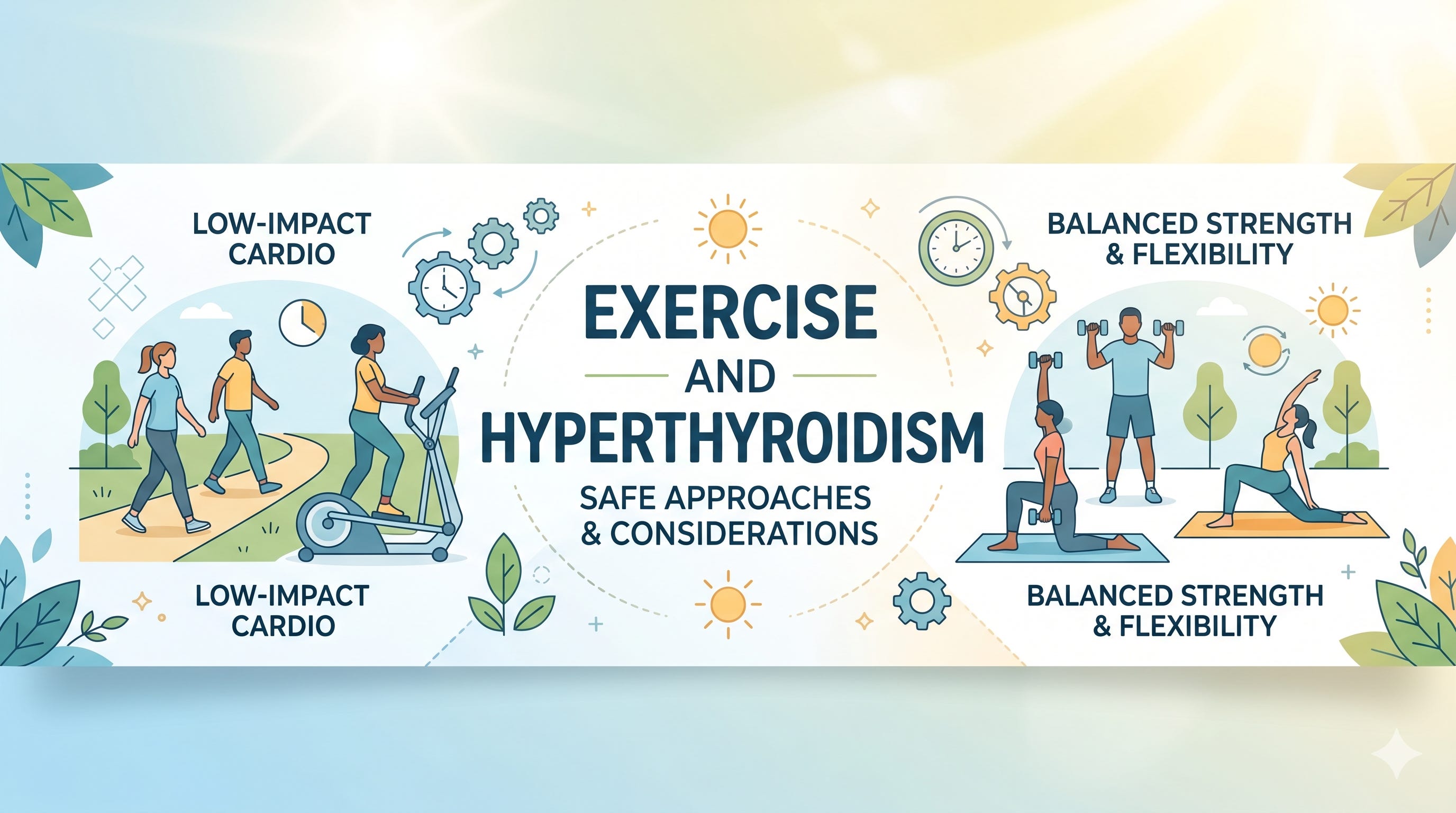
Once again, this depends on the person. However, I find that most people with hyperthyroidism can engage in light aerobic exercise (such as walking) along with some resistance training.
That said, I have people all the time tell me that their resting pulse rate increases just from moving around the house. This doesn’t mean they need to be completely sedentary, but it does suggest that they need to do a better job of managing their hyperthyroidism.
And that’s another important point—if someone is doing a good job managing their hyperthyroidism with antithyroid medication or natural agents such as bugleweed or L-carnitine, they may be able to tolerate more activity than someone with unmanaged hyperthyroidism.
However, even in this situation, you still want to be cautious. Just because your pulse rate is under control doesn’t mean your adrenals and immune system are ready for more intense exercise.
Resistance Exercise and Hyperthyroidism

As I mentioned earlier, most people with hyperthyroidism can do some resistance exercise. One of the reasons I encourage this is because it can help support muscle mass and bone density—both of which are often reduced in people with hyperthyroidism.
Just keep in mind that you won’t build much muscle if your thyroid hormone levels remain elevated, which is yet another reason why symptom management is important.
So what type of resistance exercise should you do? That really is up to you. You can use your own body weight with exercises such as push-ups, lunges, squats, and triceps dips. Or you can use free weights or machines at the gym to work different muscle groups.
Exercises like squats and deadlifts can also help support bone density in the lower back and hips.
Just be sure to maintain proper form, especially when lifting weights. Always start light—particularly if you’re new to a specific exercise—and consider working with a personal trainer if needed.
Aerobic Exercise and Hyperthyroidism

Besides walking, are there other types of aerobic exercise you can do? As I’ve mentioned, it depends on the person and how well their hyperthyroidism is being managed.
One simple guideline is this: if you can’t carry on a conversation while exercising, you’re probably doing too much. And of course, if you experience symptoms such as shortness of breath, dizziness, or lightheadedness, you should scale things back.
In addition to walking, some people may be able to tolerate swimming, or light activity on an exercise bike or elliptical machine.
And don’t forget about simple, enjoyable forms of movement—gardening, light hiking, or even slow dancing can all be great options.
Overtraining Concerns
When I was diagnosed with hyperthyroidism, I was doing a lot more aerobic exercise than I do now. While it’s possible to overtrain with resistance exercise, it seems much more common with aerobic activity.
This was definitely the case for me. While I did lift weights, I was also doing a lot of high-intensity aerobic exercise, and I’m pretty confident this had a negative effect on my adrenal health and contributed to the development of my Graves’ disease condition.
While you don’t want to be sedentary, overtraining can be just as problematic. Not only can it act as a trigger, but if you’ve already been diagnosed with Graves’ disease, overtraining can also interfere with your ability to heal.
And this isn’t limited to Graves’ disease—it can apply to other types of hyperthyroidism as well.
Final Thoughts
Exercise is important for overall health, but when you have hyperthyroidism, it’s all about finding the right balance. Doing too little isn’t ideal, but doing too much—especially high-intensity exercise—can set you back.
If you’re dealing with hyperthyroidism, focus on gentle, consistent movement, perhaps some resistance exercise, and listen to your body. As your health improves, you can gradually increase your activity level.
But in the early stages, it’s better to err on the side of caution rather than push yourself too hard.
Thank you for subscribing to Healing Graves’ Naturally! If you know anyone who has hyperthyroidism who is looking to save their thyroid, please share this with them right away.
Are You Ready to Heal Your Hyperthyroidism?
If you have Graves’ disease or a different type of hyperthyroidism and are looking to save your thyroid and regain your health, here are some other resources you might find helpful:
1. Save My Thyroid Podcast. While most of the guest interviews can benefit those with hyperthyroidism AND Hashimoto’s, there are many solo episodes that focus on hyperthyroidism. Most of the podcasts are uploaded to my YouTube channel.
—> https://savemythyroid.com/podcast-2/
—> http://www.savemythyroid.com/YouTube
2. Hyperthyroid Books. I have three thyroid-related books, two of them which focus on hyperthyroidism. Natural Treatment Solutions for Hyperthyroidism and Graves’ disease is in it’s third edition, and my latest book is The Hyperthyroid Healing Diet.
—> https://savemythyroid.com/book
3. Healing Graves’ Naturally Skool Community. When you join you get access to my Graves’ Survival Roadmap Training, and there is also a free monthly Hyperthyroid Healing Diet Q & A call with one of my nutritional health coaches.
—> https://www.savemythyroid.com/healgravesdisease
4. Hyperthyroid Healing Strategy Call. This is for those who are ready to dedicate time, energy, and finances to work with me one-on-one in my Hyperthyroid Health Restoration and Optimal Health program. I’ve been working with hyperthyroid patients since 2009, and personally dealt with Graves’ disease and restored my own health.